Number Sequence Solver
Type the numbers you know, with ? for any missing term, and see the rule, the formula and the next terms.
The number sequence solver finds the rule behind a list of numbers, then shows the next terms and fills in any missing values. You type the terms you know, and it returns the rules that fit them, the simplest first. It works as a number pattern solver, a next number in sequence solver and a missing number finder. It runs in your web browser, is free, needs no sign-up, and has nothing to install.
It works for many kinds of patterns: adding the same amount each time, multiplying by the same number, square and triangular numbers, Fibonacci-style sums, primes, and polynomial patterns. It also handles sequences of letters (A = 1 up to Z = 26) and fractions. Use it to check homework, prepare for aptitude tests, or explore why a pattern works.
How to use the Number Sequence Solver
- Type your known terms into the Your sequence box. Separate them with commas or spaces. You need at least 3 terms and can enter up to 60.
- Write ? or _ for each missing term. You can use several placeholders anywhere in the list.
- Open Terms are and choose Detect automatically, Numbers, or Letters (A = 1 … Z = 26). Choose Letters for sequences such as A, C, E, ?. Letters wrap around, so 27 is A again.
- Set Next terms to show from 1 to 20. The default is 5.
- If you want a specific position, enter a number in Find term number n. The tool gives the n-th term of every rule it finds.
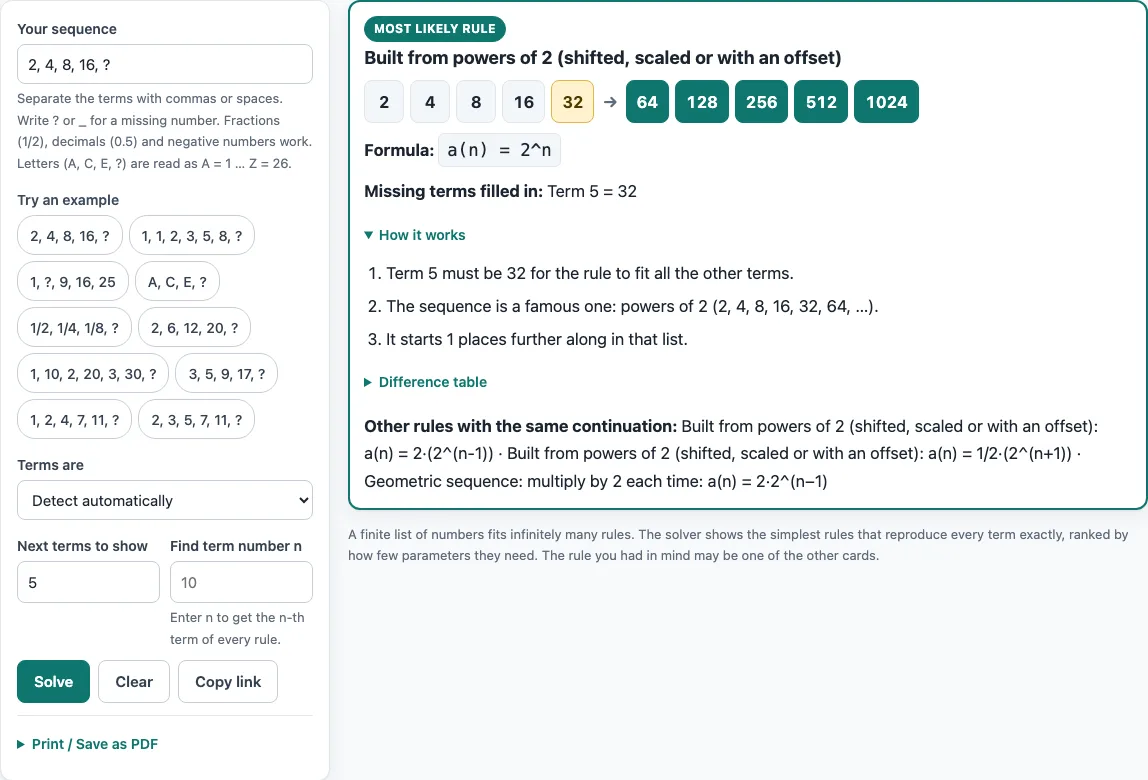
- Press Solve, or just keep typing: results update as you type, so you can fix a typo and see the change at once. Read the result cards. Each card shows the rule in words, its formula, the next terms, the filled-in missing terms, How it works, a Difference table, and Other rules with the same continuation.
Use the example chips to try a sequence before entering your own: 1, ?, 9, 16, 25 shows a filled gap, and A, C, E, ? shows letter mode. Print / Save as PDF prints the solution on US Letter or A4 paper. Copy link creates a link that shares your sequence.
How do you find the next number in a sequence?
Look for a rule that links each term to the one before it, or to its position. Start with the simplest checks: is the same number added each time, or is each term multiplied by the same number? If neither works, look at the differences between terms and then at the differences of those differences.
For 2, 4, 8, 16, each term is double the one before, so the next terms are 32, 64, 128. The formula is a(n) = 2^n. For 2, 6, 12, 20, the differences are 4, 6, 8, so the next term is 30, and the rule is n(n + 1).
How do you find a missing number in a sequence?
Find the rule using the terms you do have, then calculate the position of the gap and put that value in. The missing value must fit the same rule as every other term.
In 1, ?, 9, 16, the terms are square numbers, so the missing value is 2² = 4. In A, C, E, ?, each letter moves forward two places, so the missing letter is G. Tests sometimes hide several values, so check that your rule works for all the known terms before you rely on it.
What is a difference table (finite differences)?
A difference table is a way to see the pattern in a sequence. Write the differences between neighbouring terms in one row. Then write the differences of that row in the next row, and continue until a row becomes constant. If the first row is constant, the sequence adds the same number each time. If the second row is constant, the sequence follows a quadratic rule.
Take 1, 2, 4, 7, 11. The first differences are 1, 2, 3, 4. The second differences are 1, 1, 1, which are constant. The rule is a(n) = (n² − n + 2) / 2, and the next term is 16.
Can a sequence have more than one answer?
Yes. Any finite list of numbers fits infinitely many rules, so no list proves one single continuation. The solver checks each rule against every term you entered, ranks the simplest rules first, and shows up to three different rules. Puzzle and test questions almost always intend the simplest rule, so start with the first card.
The Other rules with the same continuation section lists different formulas that give the same next terms: 3, 5, 9, 17 can be read as 2^n + 1 or as “multiply by 2, then subtract 1”, and both continue with 33. Rules that continue differently appear as separate cards; pick the one that matches the context of your question.
Frequently asked questions
Is the number sequence solver free, and do I need an account?
Yes, the solver is free. You do not need to sign up or create an account. Because it runs in your browser, there is nothing to install.
Does it work on a phone or tablet?
It runs in the web browser, so you can open the page in a phone or tablet browser and use it in the same way as on a computer. Nothing needs to be downloaded.
What kinds of sequences can it find?
It checks constant sequences, arithmetic and geometric sequences, polynomial sequences of degree 2 to 4, famous sequences such as squares, primes, and Fibonacci numbers, and recurrences such as a(n) = a(n−1) + a(n−2). It also checks sequences that mix two patterns on odd and even positions.
Does it round the numbers?
No. All arithmetic is exact, using fractions where needed, so results do not have rounding errors. Every rule is checked against all the terms you gave before it is shown.
Can it solve letter sequences?
Yes. Choose Letters (A = 1 … Z = 26) or let it detect them: A, C, E, ? becomes 1, 3, 5, ?, the rule is “add 2”, and the answer is shown as the letter G.
Related tools
- Math logic puzzles: Use this when you want practice with number reasoning in a puzzle format.
- Brain teasers: Try these when you want short, varied problems that test pattern spotting.
- Truth table generator: Use this to list every combination of true and false values for a logical statement.
- Monty Hall simulator: Use this to test the Monty Hall problem by running many simulated games.
- Matchstick puzzles: Try these for visual puzzles that require moving or removing matches.
- Logic puzzles with answers: Use this printable pack when you want puzzles and answers for a worksheet or class.
- Logic puzzles: Go to the home page to browse all the puzzles and tools.