Monty Hall Problem Simulator
Pick a door, watch the host open a goat door, then stay or switch. Or simulate thousands of games and compare the win rates.
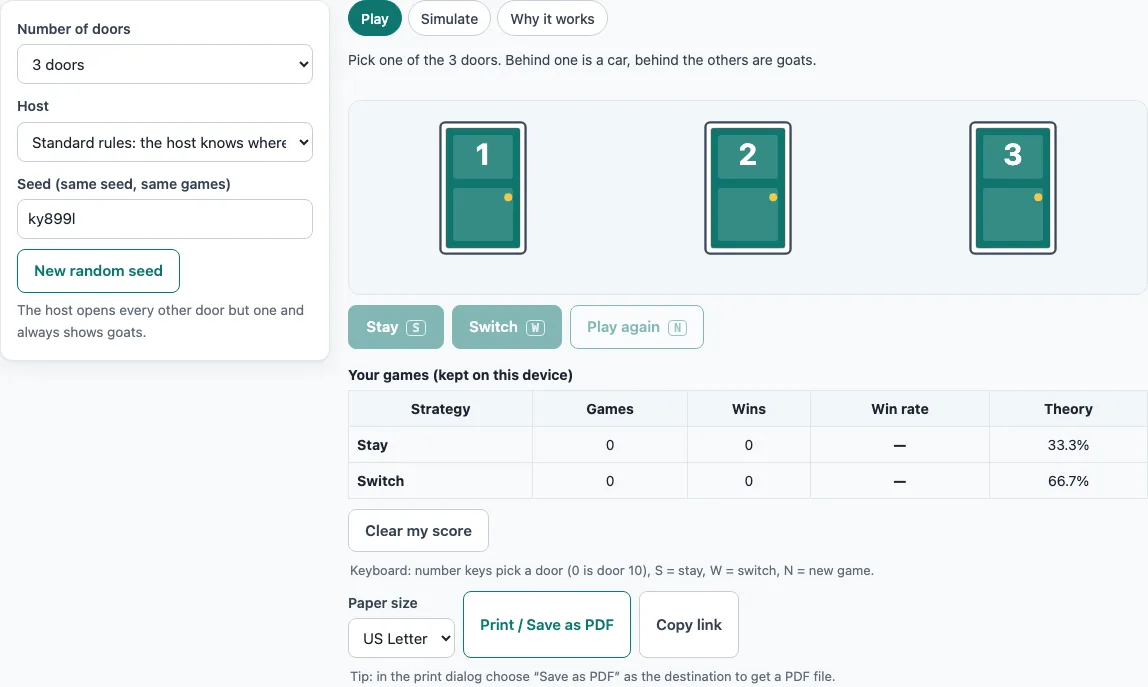
How to use the Monty Hall simulator
- Open the Play tab. Before your first game, set Number of doors (3 to 10, default 3) and Host (standard rules, where the host knows, or Monty Fall: the host does not know).
- Pick a door.
- The host opens doors that show goats. Choose Stay or Switch.
- Read the reveal, then click Play again. Your games, wins and win rate are tallied for each strategy and shown next to the theory. Use Clear my score to reset them. Scores are kept in this browser.
- Open the Simulate tab. Pick a value for Games to play: 10, 100, 1,000, 10,000 or 100,000.
- Click Run simulation. Stay and Switch are scored on the same random games. Compare their wins and win rates with the exact theory, then check the chart “Win rate as the games add up”. Dashed lines show the exact theory.
- Read the table of the first 20 games: car behind, first pick, host opens, stay result and switch result.
- Open the Why it works tab to see the probability tree and the table of all 9 equally likely cases.
Use New random seed to get different games, or keep the same seed to replay the same games. Print gives you the results with the chart, the tree, the cases and the first 20 games. Copy link shares your settings and seed, so the person who opens the link sees the same numbers.
What is the Monty Hall problem?
The Monty Hall problem is a probability puzzle with three doors. Behind one door is a car, and behind the other two are goats. You pick a door, then the host, who knows where the car is, opens another door that shows a goat and offers you the chance to switch. The puzzle is named after Monty Hall, host of the TV game show Let’s Make a Deal. Switching wins 2 times in 3, and staying wins 1 time in 3.
Monty Hall problem explained: why is switching better?
Your first pick is the car only 1 time in 3. That means in 2 games out of 3, the car is behind one of the other two doors. The host must never open the car door, so in those 2 games he is forced to leave the car behind the one remaining closed door. Switching wins exactly when your first pick was wrong. That is the whole explanation of the Monty Hall problem in one line: switching turns your wrong first guesses, 2 out of 3, into wins.
The tool’s Why it works tab shows this with all 9 equally likely cases (car behind door 1, 2 or 3, crossed with your first pick of door 1, 2 or 3). Staying wins in 3 of the 9 cases, and switching wins in 6 of 9.
What if the host does not know where the car is?
If the host opens a door at random, he may reveal the car by accident. That happens in 1 out of 3 games, and those games are void because there is no choice to compare. In the remaining games, staying and switching each win half the time.
In the simulation with the seed demo and 10,000 games, 3,329 games were void, stay won 49.6% and switch won 50.4%. The host’s knowledge is what makes switching better. Choose Monty Fall: the host does not know in the Host setting to test this yourself.
What happens with more doors?
With N doors, the host opens N minus 2 goat doors, so exactly one other door stays closed. Staying wins 1 in N times, and switching wins (N minus 1) out of N times. With 3 doors, that is 1/3 for staying and 2/3 for switching. With 10 doors, it is 10% for staying and 90% for switching.
The simulator confirms this with 10 doors and 10,000 games: stay won 9.98% and switch won 90.02%.
Who was Marilyn vos Savant and why was there a controversy?
Marilyn vos Savant answered the puzzle in her Parade magazine column in 1990, and her answer was to switch. She received thousands of letters, many from people with PhDs, saying she was wrong. The objection usually went like this: once one goat door is open, the two closed doors look equally likely to hide the car.
That intuition misses the host’s role. The host’s choice is not random, so it carries information. The simulator shows the outcome of 100 games with the seed demo: stay won 35 and switch won 65. Some people call the puzzle the Monty Hall paradox, but it is a counterintuitive result, not a real contradiction.
Frequently asked questions
Is the Monty Hall simulator free?
Yes. It is free to use, and everything runs in your web browser.
Do I need an account to use it?
No. There is no sign-up. Your scores from the Play tab are kept in your browser, and Clear my score resets them.
Does it work on a phone or tablet?
Everything runs in the web browser with nothing to install, so you open it the same way on a tablet or phone as on a computer.
Is switching the monty hall problem answer?
Yes. Switching wins 2 times in 3 with three doors, while staying wins 1 time in 3.
Why don’t my results match exactly 1/3 and 2/3?
Random games vary, and small samples can swing a lot. With 10,000 games the seed demo gave staying 32.9% and switching 67.1%, close to the exact 1/3 and 2/3. Larger game counts usually land closer to the theory.
Can I share the exact same games with someone?
Yes. Use Copy link to share your settings and seed. Anyone who opens the link gets the same games and the same numbers.
Does a bigger number of games make the simulation more accurate?
Yes. The chart “Win rate as the games add up” shows the win rates settling toward the dashed lines as more games are played. 100,000 games take well under a second.
Related tools
- Brain teasers: Try more puzzles that reward careful thinking about probability and logic.
- Math logic puzzles: Use this when you want number-based puzzles with clear rules.
- Truth table generator: Use this to check logical statements systematically, row by row.
- Logic puzzles with answers: Get a printable pack when you want puzzles with worked solutions.
- Mastermind code breaker: Practice deduction by narrowing down a hidden code from feedback.
- Riddles with answers: Browse riddles when you want short puzzles with answers included.
- Logic puzzles (home): Explore the full range of puzzles on the site.