Lateral Thinking Puzzles with Answers
Read the strange story, ask yes/no questions or open the hints, then reveal what really happened. Play alone or host a group game.
Lateral thinking puzzles are short, strange stories that you solve by asking yes/no questions until you work out what really happened. This page gives you 61 lateral thinking puzzles with answers, each with a story, hints and common questions, plus a group mode for playing with friends. Everything runs in your web browser. It is free, needs no sign-up, nothing to install, and nothing is uploaded.
The puzzles come in three levels (easy, medium and hard) and four kinds: Classic, Short puzzles, Short lateral riddles and For kids. Whether you want to solve lateral thought puzzles alone, try a lateral thinking riddle over coffee, or run a game for a whole class, the story and answer stay in one place so you can start straight away.
Printed cards and host sheets can be used at home, at events or in products you sell, such as an Etsy card set.
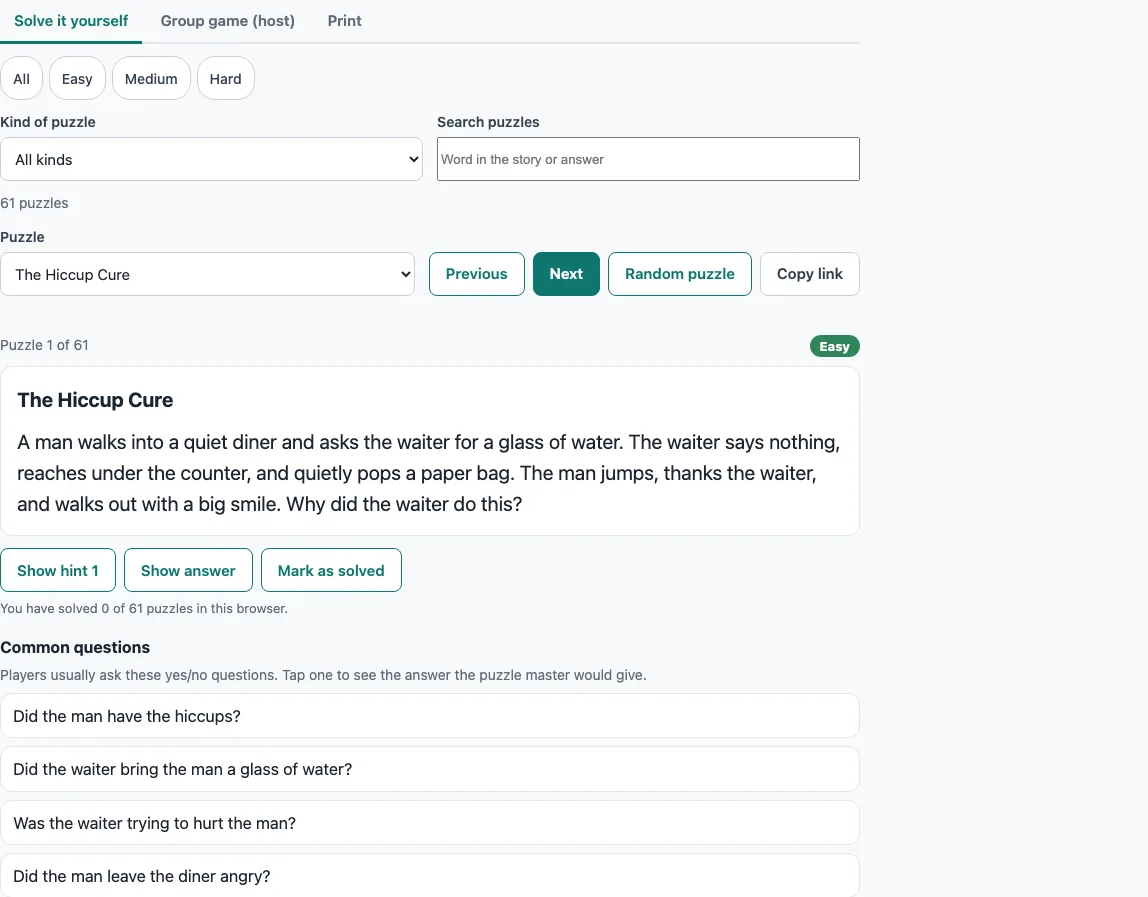
How to use the Lateral Thinking Puzzles tool
Solving alone (Solve it yourself tab):
- Open the Solve it yourself tab. The story appears on a story card.
- Open Common questions and tap each question to reveal its answer (Yes, No or Irrelevant), one tap at a time.
- Tap Show hint 1 first. Use Show hint 2 or Show hint 3 only when you are stuck, as the hints get stronger.
- Tap Show answer to check your idea.
- Tap Mark as solved to add a Solved badge. The badge is remembered in this browser.
- Use Previous, Next or Random puzzle to move on, or pick a puzzle from the picker.
Playing with a group (Group game (host) tab):
- The host opens the Group game (host) tab and taps Show story and answer to the host. This is hidden by default so players cannot read it.
- Read the story aloud. Answer each question with the big Yes, No or Irrelevant buttons. The tool counts the questions, and Undo last and Reset count fix mistakes.
- Use Start timer, Pause, Resume and Reset timer for the timer.
- For a shared screen, open Player view (big text). Tap Reveal the answer when the group gives up or solves it.
Filter by level, kind or Search puzzles. The Print tab makes Puzzle cards (4 per page) with answers after them, or Host sheets (one puzzle per page). Copy link shares the current puzzle.
What is a lateral thinking puzzle?
A lateral thinking puzzle, also called a situation puzzle, is a short story about an event that seems odd or impossible. The solver works out what really happened, usually by asking questions that can be answered yes, no or irrelevant. The answer depends on an assumption that the listener makes without noticing.
Take the classic, easy example: a man walks into a quiet diner and asks for a glass of water. The waiter pops a paper bag behind the counter, the man jumps, thanks him and leaves smiling. Most people assume the man was thirsty and the bag was a prank. The real answer is that he had hiccups, and the sudden fright cured them. The hidden assumption was about why the man wanted water.
How do you solve lateral thinking puzzles?
Start with broad questions, such as “Is anyone hurt?” or “Is it a game?”, and then narrow down. The key step is to test every assumption in the story, because the answer usually depends on one thing you took for granted.
Here is a method that works well:
- List the assumptions. Write down what you think is true about the people, place, time and purpose. Ask yourself which ones you would be surprised to find wrong.
- Ask questions that test one assumption at a time. A question like “Was the car working?” is easier to answer than “What is going on?”
- Change the setting in your head. The medium example shows this: a man pushes his car up to a hotel, says he is bankrupt and hands over everything he owns, and the owner is not surprised. Once you stop picturing a real hotel and a real bankruptcy, the answer becomes clear: they are playing a board game, and the car is his playing piece.
- Look for double meanings. Short lateral riddles often work this way. A man walks home through heavy rain with no hat or umbrella, yet not one hair gets wet, because he is bald. In a game her team loses 3-0, yet a girl scores all three goals, because they are own goals.
- Use hints as a reset. If you have asked many questions without progress, a hint can point you to the assumption you need to drop.
In a group, the host knows the answer, and players should only ask questions that can be answered with yes, no or irrelevant. Keep track of what you have ruled out so each question narrows the field.
Frequently asked questions
Is the lateral thinking puzzles tool free, and do I need an account?
Yes, it is free and needs no sign-up. It runs in your web browser, so there is nothing to install.
Does it work on a phone or tablet?
Yes, because everything runs in the web browser, you can open the page on a phone or tablet and use it the same way. Nothing needs to be downloaded.
Can I print the puzzles?
Yes. The Print tab can make puzzle cards or one-puzzle host sheets, and you can leave the answers off the printout.
How do I play lateral thinking puzzles in a group?
One person acts as the host and reads the story aloud while keeping the answer hidden. Players ask yes, no or irrelevant questions, and the host answers them until the group works out what happened.
Are the answers shown when I open a puzzle?
No. The answer stays hidden until you tap “Show answer” on the Solve it yourself tab, so you can try the puzzle first.
Are there lateral thinking puzzles for children?
Yes. Filter by the For kids kind to see puzzles written for younger players.
Can I sell lateral thinking puzzle cards on Etsy or in a KDP book?
Yes. Puzzle cards and host sheets you print are free for personal, classroom and commercial use, including Etsy printables, KDP books, Teachers Pay Teachers and print-on-demand. The puzzles in the bank were written for this site. It is royalty-free and no credit is needed. The only thing you may not do is copy the generator or the site to run a competing service.
Related tools
- Riddles with answers — use this when you want short riddles with one-line answers.
- Brain teasers — use this for a wider mix of puzzles that test thinking in different ways.
- Rebus puzzles — use this when you want to decode pictures, letters and words together.
- Knights and knaves puzzles — use this for logic puzzles about who always tells the truth and who always lies.
- River crossing puzzles — use this for step-by-step planning puzzles with strict rules.
- Logic puzzles with answers (printable pack) — use this when you want a printable set of logic puzzles to solve on paper.
- Logic puzzles (home) — use this to browse the full range of puzzles on the site.