How Long Is a Billion Seconds?
A billion seconds is about 31.69 years. Change the amount or the unit to convert your own number, or add it to a date.
Recent
Your last 10 settings, saved only in this browser. Nothing is uploaded.
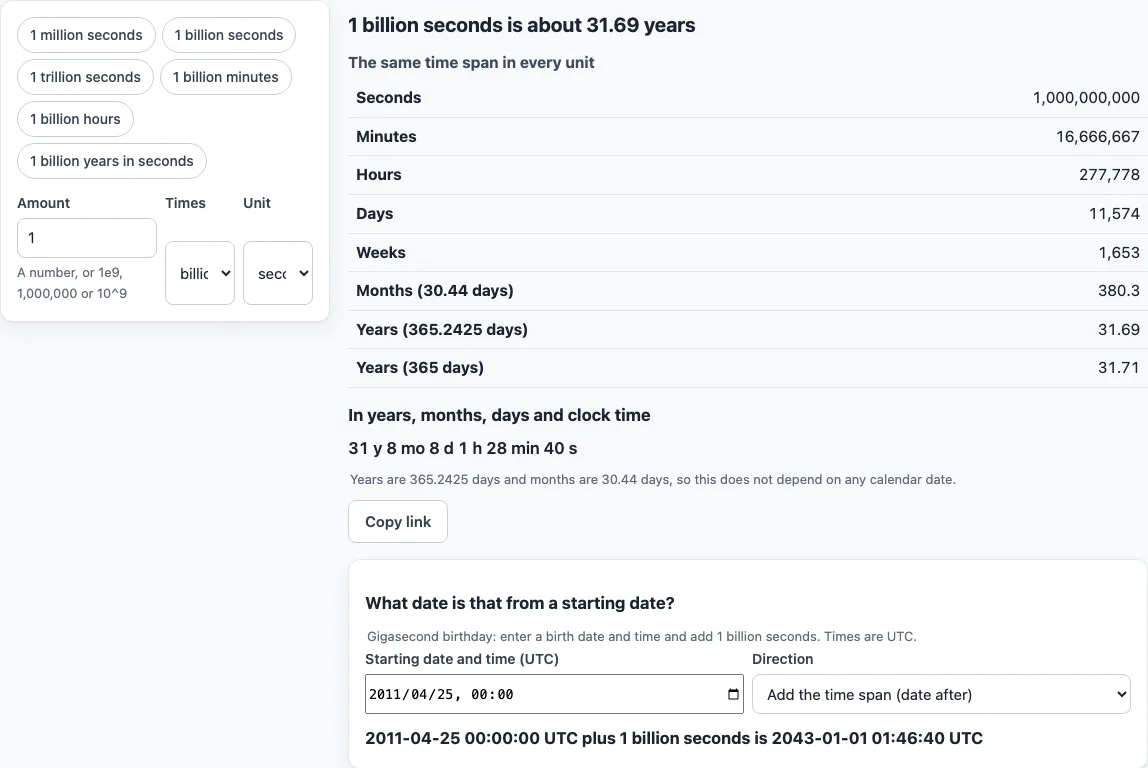
A billion seconds is about 31.69 years, or 11,574 days. This free calculator shows how long a billion seconds is, and it converts any other amount of seconds, minutes, hours, days, weeks, months or years into the other units. It runs in your browser with no sign-up, and nothing you type is sent anywhere.
The page opens on 1 billion seconds. Pick a different example, such as 1 million seconds or 1 trillion seconds, or type your own number and choose a unit. A second panel adds or subtracts the time span from a date, so you can find the day you will have lived a billion seconds.
How to use the billion seconds calculator
- Type a number in the Amount box. You can write it as 1000000, 1,000,000, 1e9 or 10^9.
- Pick a multiplier in Times: thousand, million, billion or trillion. Choose “1 (as typed)” if you typed the whole number.
- Pick the Unit (seconds, minutes, hours, days, weeks, months or years). The result updates as you type.
- Read the headline for the answer in years. The table below it shows the same time span in every unit, and the line under the table breaks it into years, months, days and clock time.
- To find a date, enter a starting date and time in the second panel (UTC) and choose whether to add the time span or subtract it. The result date appears below.
- Click Copy link to share your numbers. The address bar keeps them.
The preset buttons load common examples, such as 1 million seconds, 1 billion seconds, 1 trillion seconds, 1 billion minutes, 1 billion hours and 1 billion years in seconds. If you type something the tool cannot read, such as letters or a negative number, a short message under the boxes tells you what to change. The largest amount accepted is 1e24 seconds. Very large results appear as 3.16 × 10^16.
The breakdown line uses fixed averages (a year of 365.2425 days and a month of 30.44 days), so the same number always gives the same answer. The date panel is the only part that depends on a calendar, because it counts real days between two dates.
How long is a billion seconds?
A billion seconds is 1,000,000,000 seconds. Divide by 86,400 seconds in a day and you get 11,574 days with 6,400 seconds left over. Divide by the length of an average year (365.2425 days, or 31,556,952 seconds) and you get 31.69 years. Written out, that is 31 years, 8 months, 8 days, 1 hour, 28 minutes and 40 seconds.
If you use a simple 365-day year, the answer is 31.71 years. The two figures differ by about a week because the 365.2425-day year also counts leap years.
How many years is a billion seconds, and how many days?
About 31.69 years, or 11,574 days. In other units, a billion seconds is about 16.7 million minutes, 277,778 hours and 1,653 weeks. Because the table uses fixed averages for years and months, the answer never depends on which dates you pick.
How long is a million seconds, and how long is a trillion seconds?
A million seconds is 11.57 days (11 days, 13 hours, 46 minutes and 40 seconds). A trillion seconds is about 31,689 years. A million seconds is a little over a week and a half, a billion seconds is a human generation, and a trillion seconds is longer than recorded history.
How many seconds are in a billion years?
One billion years is about 3.16 × 10^16 seconds (31,556,952,000,000,000, using the 365.2425-day year). Choose “billion” and “years” in the calculator to see it.
How long is a billion minutes, a billion hours or a billion days?
A billion minutes is about 1,901 years. A billion hours is about 114,079 years. A billion days is about 2.74 million years. The presets load the first two.
What is a gigasecond birthday?
A gigasecond is a billion seconds. The date you turn a billion seconds old is a gigasecond birthday, and it comes about 31.7 years after you were born. To find yours, enter your birth date and time in UTC in the date panel and add 1 billion seconds. For example, 1990-01-01 00:00 UTC plus a billion seconds is 2021-09-09 01:46:40 UTC, and 2011-04-25 00:00 plus a billion seconds is 2043-01-01 01:46:40 UTC.
The tool counts whole SI seconds on the Unix time scale and does not count leap seconds, so the result can differ by a few seconds from a count that does. The date is shown in UTC, so in your time zone it may fall on the day before or after.
How do the date results work?
The date panel adds the exact number of seconds to your starting date-time in UTC. It handles years outside 0000 to 9999 up to the range a browser date supports. The time span is converted to whole seconds first, and fractions of a second are rounded.
Frequently asked questions
Is a billion seconds longer than a lifetime?
A billion seconds is 31.69 years, so it is about 40 percent of a person’s life if they live to 80. A trillion seconds is far longer than a lifetime.
What is the exact number of days in a billion seconds?
1,000,000,000 divided by 86,400 is 11,574.07 days. That is 11,574 whole days and 6,400 seconds, which is 1 hour, 46 minutes and 40 seconds.
Why does the answer depend on the kind of year?
Years are not all the same length. An ordinary year has 365 days, and the Gregorian calendar adds a leap day about every four years, giving an average of 365.2425 days. This calculator shows both the 365.2425-day and the 365-day answers so you can compare. Months use one twelfth of the average year.
Does the calculator work for any unit?
Yes. You can start from seconds, minutes, hours, days, weeks, months or years, and the result table shows all of them. The largest amount allowed is 1e24 seconds.
Can I use it on a phone?
Yes. It runs in the browser on any phone or tablet, and the table and date panel resize to the screen.
Is it free to use the results?
Yes. The numbers are plain arithmetic. You can use the results in a class, a blog post, a trivia quiz or a puzzle book, and no attribution is needed. The only limit is that you may not copy the tool itself to run a competing service.
Related tools
- Brain Teasers: Use it for a mix of puzzles, riddles and number questions.
- Number Sequence Solver: Use it to find the rule in a list of numbers.
- Math Logic Puzzles: Use it for printable number and logic puzzles with answers.
- Monty Hall Simulator: Use it to test a famous probability puzzle.