Logic Puzzles: Free Logic Grid Problems
Use the clues to match every person with one item from each category. Pick a size and difficulty, play on screen or print with answers.
Recent
Your last 10 settings, saved only in this browser. Nothing is uploaded.
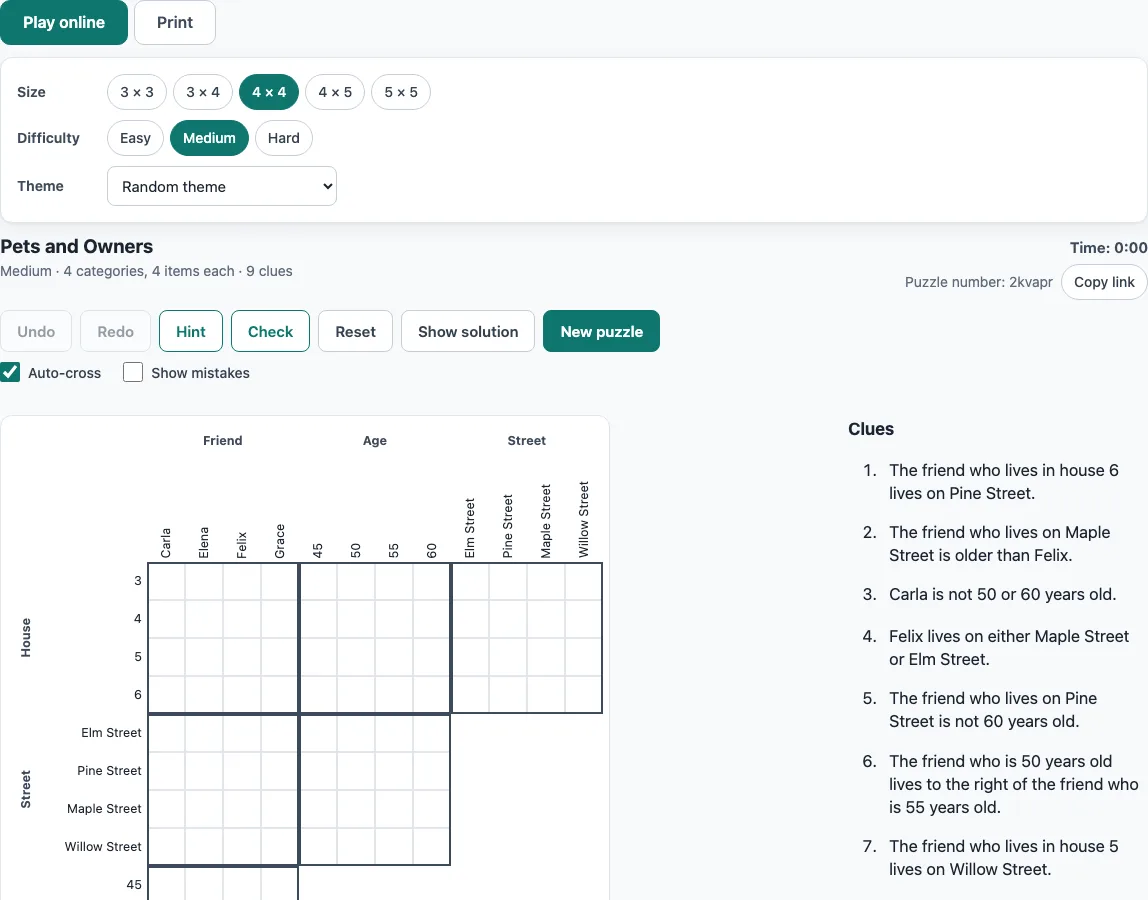
How to play the logic puzzle on this page
- Open the home page. A 4x4 medium logic grid is ready to play.
- To change the puzzle, pick a size chip (3x3, 3x4, 4x4, 4x5 or 5x5) and a difficulty chip (Easy, Medium or Hard). Press New puzzle for a different puzzle with the same settings.
- Read the clues. Tap a clue to cross it out once you have used it.
- Mark the grid. Tap a cell once for ✗ (no) and twice for ● (yes). Right-click or press and hold to place ● directly.
- Watch the Your answer table under the grid. It fills in from your ● marks.
- If you are stuck, press Hint. It marks one cell and names the clue and the reasoning behind it.
- Press Check to see how many marks are wrong. It does not show which ones.
- Press Show solution when you want the full answer.
You can also use the keyboard: arrow keys move, X or Space places ✗, O or Enter places ●, and Backspace clears a cell. Undo, Redo and Reset are available as buttons. To share the exact puzzle, use Copy link. To print, open the Print tab, set the options, and choose Print / Save as PDF.
Printed puzzles are free to use at home, in class or in products you sell, such as Etsy printables or KDP puzzle books.
What is a logic puzzle?
A logic puzzle is a problem you solve by reasoning from clues, with no guessing needed. A logic grid puzzle, also called an Einstein puzzle, zebra puzzle or deduction puzzle, has several categories with the same number of items in each. For example, it might have 4 friends, 4 pets, 4 ages and 4 drinks. The hidden answer pairs every item with exactly one item from each other category, and each item is used once. The clues are the only information you get.
How do you solve logic puzzles?
Start with the clues that state a fact directly, such as “Fay drinks lemonade.” Mark those pairs first, because every mark rules out other options in the same row and column. Then use the clues that link facts together. If a clue says two things are linked and you know one of them, you know the other. Keep going until each row has exactly one yes.
Here is a short example from a 3x3 easy puzzle. Fay drinks lemonade and Gus drinks milk, so Cara must drink cocoa. The clue “the child who drinks cocoa also has grapes” then gives Cara the grapes. The last clue says the oranges do not go with lemonade, so Gus has the oranges and Fay the bananas: Cara – grapes – cocoa, Fay – bananas – lemonade, Gus – oranges – milk.
What kinds of logic puzzles are there?
The site has several types of logic puzzle. Logic grids are the main type here, in sizes from 3x3 to 5x6 (written categories × items), with the first category always the names. Knights and knaves puzzles ask you to work out who tells the truth and who lies. River crossing puzzles ask you to move people or things across water under rules, such as the wolf, goat and cabbage problem. Water jug puzzles ask you to measure an exact amount, such as 4 litres, using a 3 litre and a 5 litre jug. Matchstick puzzles ask you to move, remove or add sticks to make a sum true, and the Mastermind-style code breaker asks you to find a hidden code from feedback on your guesses.
Are there logic puzzles for kids or for adults?
Yes. The tool includes 6 kid-friendly themes, such as lunch boxes, alongside 10 everyday themes. Easier grids suit children, while harder grids suit adults who want a longer challenge. Difficulty is set with the Easy, Medium and Hard chips, and the site has separate pages for kids and for harder puzzles.
Frequently asked questions
Is it free, and do I need an account?
It is free, and you do not need an account or sign-up. Puzzles are made on your device, and nothing is uploaded.
Does it work on a phone or tablet?
The tool runs in the web browser, so there is nothing to install on a phone or tablet. You mark the grid by tapping cells, and large grids scroll inside their own box on a small screen.
Can I print logic puzzles with the answers?
Yes. On the Print tab you can choose how many puzzles appear per page, from one to ten pages, and choose US Letter or A4 paper. You can turn answer pages on or off, add a name and date line, and select large print. Answer pages show the filled answer table and the solved grid.
What is a puzzle number?
Each puzzle is made from a puzzle number, also called a seed. The same number and settings always give the same puzzle. Use New puzzle to get a different one with the same settings.
How is difficulty decided?
Difficulty is measured, not guessed. The level is the weakest set of solving rules that can solve the finished puzzle. Easy puzzles use direct clues and simple linking, while Medium and Hard puzzles need more advanced rules.
Will I lose my marks if I reload the page?
No. Your marks are saved in your browser for each puzzle, so a reload keeps your progress.
What does the timer count?
A timer runs while you play and pauses when the page is hidden. When you finish, a message shows your time and how many hints you used.
Can I sell logic grid puzzles from this page on Etsy or in a KDP book?
Yes. Puzzles you print are free for personal, classroom and commercial use, including Amazon KDP puzzle books, Etsy printables, Teachers Pay Teachers and print-on-demand. It is royalty-free and no credit is needed. The only thing you may not do is copy the generator or the site to run a competing service.
Related tools
- All logic puzzles: One list of every puzzle on the site.
- Logic grid puzzles: All six sizes from 3x3 to 5x6 and an Expert level.
- Logic puzzles for kids: Choose this for easier grids and kid-friendly themes.
- Hard logic puzzles: Try this when you want larger, harder grids.
- Logic puzzles with answers: Get the printable pack when you need a set of puzzles with answers.
- Mastermind code breaker: Play this to crack a hidden code from feedback on your guesses.
- Water jug puzzle: Measure an exact amount with two or three jugs, with a step-by-step solver.
- River crossing puzzles: Try these for crossing problems with rules about who can be left alone.
- Knights and knaves puzzles: Use these to practise working out who tells the truth and who lies.
- Matchstick puzzles: Move, remove or add sticks to make a matchstick equation true.
- Brain teasers: A quick mixed quiz of riddles, rebus pictures, math and matchstick teasers, or a printable sheet.